
(Ein wichtiger Hinweis: Ich bin medizinischer Laie. Ich habe nur lange mit meiner Krankheit gelebt. Ich kann alles medizinische hier falsch verstanden oder falsch wiedergegeben haben. Jede in diesem Text wiedergegebene Information ist potentiell aus dem Zusammenhang gerissen, falsch, unvollständig. Hört auf Euren Arzt! Fehler sind meine Fehler, nicht die meiner Ärzte.Meine Erfahrungen sind anekdotisch. Eure Erfahrungen können anders sein.)
Mobilisation
You might well think that in the days after such an operation you’re first of all left in peace and stay lying in bed. But far from it. Very far from it. Attempts are made very quickly to mobilise the patient again.
First of all sit up, sit on the edge of the bed. See what your circulation does. My discharge report states that I was already on the edge of my bed in the intensive care unit. I could hardly believe it. I remember distantly that, shortly before my transfer to the normal ward, I stood very wobbly on my own legs in the intensive care unit.
The further mobilisation then took place on the normal ward. Briefly onto your own legs. See whether you stay standing. Then maybe also walk a few steps. With a walking frame. You need it, too. Really. At first you’re still quite wobbly on your legs. First of all have a supporting option, when you don’t yet really know whether the position-control systems are already back fully in operation.
The last thing you want now is to fall over somewhere and possibly land not just on your backside but on your chest. So swallow your pride and use the thing. On this occasion, though, I suddenly understood why my father doesn’t fancy a walking frame, even if it would presumably sometimes be more comfortable for him.
At first it’s tiny mincing steps that you accomplish there in your gripper socks in the hospital room. But it quickly becomes more. To the door. To the toilet. To the water bottles in the corridor.
However, it was also explained to us that we shouldn’t move too far away from the cardiac ward. For a fairly simple technical reason: you wear a cardiac monitor. A mobile ECG. It transmits the heartbeat by radio to a central monitoring station, which comes up in the ward office. You do have to walk quite far, but at some point the monitor just simply has no reception any more. Allegedly up to about beyond the door of the ward. I never tried it out.
At the beginning you don’t want that at all, either. The walk to the water bottles was enough for me there. First of all I wanted to have trust in my body again. Trust in your own body is, anyway, an overarching theme. Subsequently I often experienced that my body could do, and also wanted to do, things that my head didn’t yet have such trust in. Unsure whether it would be a good idea. That, however, only became a clearer challenge in the rehabilitation. But there too the rehab helped me: building trust. In the acute hospital, after the first hard days, you don’t yet have so many opportunities to bring yourself to a real physical limit. At least that’s how it was for me. It was always the head that limited me.
Then comes the moment at which you feel safe enough to walk without a walking frame. I was pleased when I safely managed to mince all the way to the end of the cardiac department without pushing this wheeled steel-tube contraption ahead of me. Then I walked faster. Almost as fast as I could walk before the operation, to the chagrin of some people who accompanied me on walks or hikes.
At some point I was then even in the foyer of the hospital. Not on the ground floor, but on the first floor. I could look into this foyer. The hospital has a large, open foyer. It doesn’t seem like a hospital at all there, were it not for beds visible in the corridors on some floors.
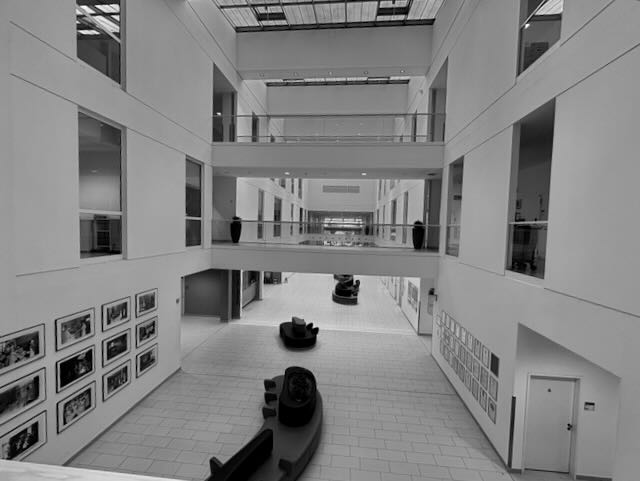
I didn’t go to the railing, though. My balance wasn’t quite a hundred per cent in order yet and at times still gave me rather strange signals. Especially at that spot in the foyer from which you could look down to the floor of the ground floor. So I kept away from the railing. It simply seemed sensible to me. I didn’t want to end up in the accident surgery department on top of everything. I only dared go to the railing on my last day in hospital, when I was on the way out. Instead I made a point of walking up and down the corridor faster and faster.
And then my radius of action suddenly reduced, due to the corona infection, to a single room. A large room for myself. But just one room. Okay, there was also a room for the shower and a toilet. But that’s not noteworthily more radius of action. And I couldn’t shower properly for a long time. Hit, sunk. This restriction was to take a nasty toll on me. But more on that in the next chapter.
Pain
My chest was opened. I didn’t really have a problem with it happening. I knew, after all, that this step was unavoidable for the planned operation. But I’d crashed often enough on the mountain bike that I knew that, for example, bruised ribs can be very painful for a long time. How painful, then, would it be when these are cleared out of the way for the operation? In my mind I’d already prepared myself for very unpleasant times there.
But: I had astonishingly little pain after my operation. They had the subject of pain well under control in the hospital. I was so well adjusted in terms of medication that it was actually more than bearable. It was really astonishingly okay.
I didn’t ask what tablets I was getting in the first days. There were simply a large number of tablets. Some I recognised, others not. I simply assume that a number of these tablets were painkillers. And of the calibre “the good stuff” that doctors have up their sleeve when pain relief beyond paracetamol and ibuprofen is necessary.
By the way: I actually have no problems swallowing big tablets. There are these monstrous antibiotic tablets, with which you sometimes ask yourself how you’re supposed to take them. Whether there might perhaps be a concentrate version of this tablet that lets this tablet slide down the oesophagus a little more easily. But even that I manage quite well. I have to get used to it anyway. I have a prosthesis in my body. That means endocarditis prophylaxis. Taking a larger dose of antibiotics before every dental cleaning. Two of these big tablets. The joy about that keeps within narrow limits.
At the beginning, though, the problem was rather the quantity. What I had to take in the hospital at the beginning went too far even for me, to simply take the whole pharmaceutical barrage in one step with a sip of water. At some point I felt like my grandmother, for whom it was part of her daily morning ritual to take her tablets one by one with tea in the morning. So I sat in the hospital with my water bottle and took my tablets. On that note: hello Grandma, wherever you are right now, I’m almost at the pill organiser too!
Of course some things were unpleasant. But there was nothing that would have plunged me into tears somehow. I suspect the painkillers prevented that. You notice your limits fairly quickly, leave out certain movements that you know will hurt. Mostly these are the same movements that you ought to leave out at first anyway, to ensure that the chest grows cleanly back together again.
And as silly as it sounds: I found removing the plasters very unpleasant. By far. I’d even go so far as to say it was one of the most unpleasant things. It’s this special kind of pain when peeling off a plaster or an ECG electrode, to which I apparently react very sensitively.
I believe the key to sensible pain management is being honest when you’re asked how the pain is. Not, out of misunderstood machismo, making your pain look smaller than it really is. A brave warrior knows no pain. They couldn’t afford back then either to know it, because the only painkiller was the highly suspicion-arousing brews of the proto-medically knowledgeable elder. Today it looks completely different.
With the thought of taking as few painkillers as possible, you only torment yourself. You’re busy enough with getting well anyway, without also distracting yourself with pain on top.
On that note: you should perhaps also not answer with 10 out of 10 on the pain scale. 10 out of 10 is reserved for very lousy situations, if I understand it correctly. 10 out of 10 means the strongest imaginable pain. Whoever is still capable of a clear thought, is even able to express it, and answers with 10/10 either has no power of imagination or is exaggerating. And I’m sure that in every medically educated mind there’s a special place for 10/10 people, with the suspicion that the pain clearly lies somewhere else. Okay, everyone has a different pain perception. But we can, I believe, agree that “like being run over by a steamroller” ought to be reserved for special occasions in life.
That I had no pain isn’t right either, though. I’m not talking now about my exaggerated whining over plaster removal. For one thing there was the pulling of the drainage out of my chest. That is guaranteed not subject to entertainment tax. You have the drainage in your body for a few days, to ensure that fluid arising after the operation can be carried away in the operated area. That apparently doesn’t happen just with a tube hanging out. The tube is probably subjected to slight negative pressure. As soon as the doctors assess the situation such that the drainage is no longer needed, the tube is pulled.
The process of removing this drainage tube is interesting. The sutures to close the wound that the pulling of the drainage leaves behind are already present from the laying of the drainage. That happens directly during the insertion of the drainage. As soon as the drainage is out, the existing suture is quickly drawn closed, thereby closing the wound.
The process seemed to me roughly like starting a petrol lawnmower. You might get the idea to make the sounds of a starting engine. But you can forget that. In the narrow time interval in which that might be amusing, you’re too busy with yourself, too busy with the fact that this is really unpleasant. A decent blow to the stomach area is perhaps a good comparison. It hurts, but only for a few seconds. Fierce, but bearable. I’d had stronger pain during a dental treatment. But quite frankly I hope that a drainage tube is never pulled out of me again in my life.
What caused pain for longer was my chest. I clearly noticed that it had been opened. The challenge was neither to lie easily nor to move once you’d got up. That was more or less pain-free. It was basically almost normal. Only two things were really painful: sneezing and coughing hurt. Very much.
A further problem was lying down and getting up out of bed. How you should get up for the next while is taught to you very early on, within the framework of the mobilisation after the operation. You can’t really prop yourself up. That would strain the chest, and that’s currently busy healing. So you have to use a few tricks. The procedure doesn’t quite stick to the dogma “don’t prop yourself up,” but so little strain is in play at that spot that it’s probably irrelevant. Presumably.
It’s also not the case that it’s then super-sensitive. The wire cerclage is so stable that not everything falls apart straight away just because you move wrongly somewhere. That’s at least my summary of what they explained to me about it. But you do want to bring in a certain calm, so that the healing can progress.
The trick is to roll as close as possible to the edge of the bed. And already here you have to proceed differently from how you handled it before the operation. It’s important to hug yourself, to spare the chest. You quickly do that voluntarily, because rolling hurts if you forget the hugging. Then use the legs as a counterweight, to raise the body almost without propping yourself up. For this residual propping use the left arm, since I was operated on on the right side. That’s at least how I built it together for myself. I stuck almost religiously to this procedure for almost two months. Only since the beginning of December have I been getting up normally again. And even now I notice that the sequences of movement from the time after the operation are still part of my getting-up process. It will, I believe, take a long time before I get up or lie down again exactly as I did before the operation.
That was no can-do affair, either. Along the lines of: that would be better. If I wanted to get up without it becoming very painful, then I had to keep to this technique. I wanted in any case to prevent being told, in case of problems with the healing of the chest: “You should have stuck to the technique.” When lying down the same applies. Only the other way around. I could do it really quickly by the end of my time in hospital. So you can teach old dogs new tricks after all. There was one small challenge: I could only do it to one side, towards the left. To the right over the edge I never really managed it fluidly.
The second challenge was coughing and sneezing. Here too you have to hug yourself. That holds the chest together both during coughing and during sneezing and reduces the pain. That works really well.
Because simply sneezing just like that is a rather painful experience. When you notice that you’re about to sneeze, best to hug yourself beforehand. Don’t go looking for a tissue. You don’t have a hand free for that anyway. Post-pandemic sneeze and cough etiquette is really hard under these circumstances.
Holding your hand in front of your mouth or sneezing into your elbow is hard when your hands are behind your back or on your shoulders. You can’t have everything in that moment, and I hope these discourtesies have been forgiven me by now.
I just want to give one tip here: hugging yourself works decidedly better when you have a pillow to hand. In my frequent-flyer time I’d bought myself a travel pillow. The kind you can partly stuff into itself so that it takes up less space, since you also compress it while doing so. For flying in economy it was a bit impractical. It was, you see, unwieldily big for that. Unless you were sitting by the window. Then it was brilliant for bridging the gap between the outer skin and the seat.
The idea of taking it along was based on a YouTube video. I’d seen videos from the United States (“What to expect before, during and after your heart operation” … no … not with Troy McClure) that in some American hospitals a heart-shaped pillow is handed out. I didn’t receive one of those. But I did receive a breathing trainer, which was just as important.
In any case: this pillow you press against your chest. I found that more pleasant, since a little more pressure could be created on the chest, so that when coughing or sneezing it didn’t feel as if everything was just about to fly outwards and my chest was bursting open.
I was glad of the travel pillow. I wouldn’t have wanted to take a red plush heart into the hospital on top of everything. For one thing I’d have had to buy one first. I don’t keep such a thing in stock. For another, I suspected that I’d probably already be looked at oddly enough by the hospital staff over the plush Hamburger. A red plush heart would then probably have been too much.
So: take a pillow. About medium sofa-cushion size. I can recommend it.
This pillow saved me to some extent. I had to cough for a long time. I needed cough loosener for a long time after the operation. I had SARS-CoV-2, after all. I’ll spare you a closer description at this point. The pillow helped so that not every cough became really painful straight away.
By night
So you have a fairly major operation behind you. It perhaps sounds worse than it is, but you first have to come to terms with the experience of the operation. Since the operation I’ve had considerably more intense dreams. As if my head were processing the last four to six years once more in fast-forward. As if something had deleted my conclusions from the dreams. Everything has to come out again, everything has to be processed again.
I apparently dream everything again from the post-operative vantage point. Currently people and situations regularly come up in my dreams that I thought I’d long since processed. So the bloopers-and-mishaps reel of the last years. That, too, is still no different almost three months after the operation. I often wake up at night and have to shake my head at my own dreams. I wouldn’t want to tell anyone the content of the dreams. And won’t do it here either.
Some dreams, though, are new. And I have no idea where they come from. My “highlight” was particularly strange: I was in Vienna. Many people from my past were also there and played a role in the dream. Okay. That’s nothing wild yet. BUUUUT: the crazy thing was … Christoph Waltz functioned as an off-screen narrator. It was about some café that was supposed to stay in family ownership. I have neither relatives in Vienna nor is there a café in family ownership.
Since then I’ve seriously asked myself how and why I dreamed together such rubbish. That day I genuinely had doubts about my mental state.
I probably shouldn’t have watched “Alita: Battle Angel” during that day. To this day I ask myself how they managed to convince Mr Waltz and Mr Norton to act in it. Although the film is really entertaining, and entertaining is everything you want in hospital. For cultural highlights, for Polish experimental films with Finnish subtitles, there’s still enough time once you’ve left the hospital.
Even three months after the operation I don’t really have the feeling that I’ve really processed all the experiences after the operation or built them into my mental picture of the period. I think I’ll still need some time for that.
A doctor also said later that the problem, especially with people who work in an office, at some point isn’t so much the physical resilience, but that the head occupies itself with it for a long time. That the head has to recover from this situation in order to concentrate on normal life again.
Writing on the wall
That dream was presumably the intro to the time afterwards. Because it didn’t stop at the dreams. At some point I had dream-images while awake. I’ve learned that the heart-lung machine and the long anaesthetic can have very interesting consequences in the brain. Consequences that frightened me, but disappeared again after a few days. Although I knew about these consequences, they frightened me.
For a while my world looked to me like the background in the video of the Kiss version by Tom Jones and The Art of Noise. No. Actually far wilder still. Far more restless. The world was very colourful. I had the impression my brain was filling empty spaces with some kind of nonsense.
My eye saw an empty wall. Dancing figures appeared. My eye saw the grey, single-coloured sky. Patterns on it. My eye saw a lamp. RGB Bayer pattern next to it. I looked at the ceiling. Numbers. My brain turned the empty, quiet room into a Times Square or a Shibuya Crossing. Consistent with this is also that some of the characters I saw on the ceiling somehow looked Japanese.
I saw drawings on the ceiling that passed by my eye in short, constantly repeating movements. Since at night, when my eyes were closed, there were no visual stimuli at all, my entire field of vision was then filled with this.
I’ve long asked myself where artists get their inspiration from. After the experience after the operation I have a notion of it. Van Gogh is said to have suffered from migraine and to have processed that in his art too. With other artists too I now suspect similar connections.
Since my artistic abilities haven’t developed noteworthily after my third year of life, I unfortunately can’t capture what I saw in that period in drawings, but have to make do with the two comparisons above. I couldn’t, after all, take a photo of it, even if some of these sensory impressions were quite fascinating.
Since that time I harbour the suspicion that the inspiration of many artists has grown out of such situations. Be it through a suffering that, to this day, you largely just have to live with, be it through the consequences of a serious medical procedure or through what’s called in English “recreational drug use.” As if there were “occupational drug use.”
I write about it so openly, that I had hallucinations, because it isn’t rare. And from what I was told, it’s often considerably more pronounced too. It is quite a high percentage of patients who experience such a situation. Here you’re led to a limit with the heart-lung machine and anaesthetic. And the brain needs a moment to recover from it. And you should give the brain this time.
Do tell your doctors about it, though. It’s a known phenomenon. Nothing to be ashamed of. They can do something about it. For me it stayed a phase of maybe four to five days. I was already more occupied with the mental consequences of the isolation, so that the medication against it could be discontinued again.

