
(Ein wichtiger Hinweis: Ich bin medizinischer Laie. Ich habe nur lange mit meiner Krankheit gelebt. Ich kann alles medizinische hier falsch verstanden oder falsch wiedergegeben haben. Jede in diesem Text wiedergegebene Information ist potentiell aus dem Zusammenhang gerissen, falsch, unvollständig. Hört auf Euren Arzt! Fehler sind meine Fehler, nicht die meiner Ärzte.Meine Erfahrungen sind anekdotisch. Eure Erfahrungen können anders sein.)
Isolation
If I had to answer the question of what weighed on me most heavily during the time of the operation, I can – without hesitation – say: it was quite clearly the isolation in the hospital room after corona was detected in me.
Now one or another of you may say: big deal. I’ve had to do that several times at home. Well. For me it was my first corona isolation, and then right away in the very confined space of a hospital, without having the possibility of going outside.
There were two relevant ways out of this isolation. Either the test would no longer show corona, or the doctors would discharge me. Okay, third option … I could of course also have simply discharged myself, but there were further very good reasons why I was still in the hospital. Yeees … fourth option … feet first. But that was no possibility at all that I wanted to consider for an escape from the isolation.
The two realistic ways, however, took up far more time than I initially thought. That was also connected with the fact that a second problem opened up at about the same time as the corona infection. Therefore I couldn’t (and didn’t want to) be discharged immediately. That had to be sorted out first. On the other hand, the corona test didn’t want to turn negative.
In the end it was the discharge that led me out of the isolation in the hospital and required further days of isolation in my flat. Because I only turned negative a few days after my discharge, shortly before I could go into the follow-up rehabilitation treatment.
I understand this strict isolation rule of the acute hospital. Many people here are in a very vulnerable moment of their life. You don’t lie in cardiac surgery without reason. People I would have encountered on the further way through the hospital could have been much more sensitive still. The Albertinen hospital is a hospital of maximum care. You can assume that many people here aren’t here just because of a broken toe. And many had even greater health challenges than I did.
I would therefore also have isolated myself even without the hospital’s instructions. I wouldn’t have wanted to be responsible for passing corona on to someone else. Someone who’s currently fighting for their health here. I was also aware that these people could get it just as well from someone else. For example, when visiting the hospital’s cafeteria. But, isolated, I could rule out that I was the starting point. I then wouldn’t have been it.
That I still wear a mask has a very egocentric, but simple reason: if I have the illness unnoticed, then at least it wasn’t me if someone in the family circle gets corona in temporal proximity. And wearing a mask honestly doesn’t bother me. In the last years I simply found it wonderful that, up until the day I got corona in hospital, I had no really severe cold, no flu, no further infection. But I’m not afraid of illness; I’m apprehensive about illnesses in people close to me.
It’s also the other way around: I also wouldn’t want to catch corona from someone who’s aware of this infection. And that then did happen to me, too. I must have encountered some person with the infection somewhere. But I preserve the illusion that this person knew nothing of it. It just can’t be prevented. I only hated being on the wrong side of the isolation rule. And I hated that, of all people, I had this bad luck.
That I knew it was genuine coincidence. It was a test of my own with which I detected it. The hospital only found out about the illness when I called a member of the nursing staff and told her: “Better stay outside,” and showed her the test. A hospital test confirmed my finding. I was thus in isolation. And the egoism of saying nothing in such a situation is something no person with a conscience should permit themselves.
I’m not a sociable person. I don’t necessarily need people around me. But I noticed that it was utterly terrible for me not to be allowed through the door of my hospital room. It felt like a prison.
The situation was worse for me than anything else. Worse than the operation. Worse than corona itself. Worse than the pain when sneezing. Worse than the hallucinations that haunted me for a few days. Worse than plaster removal.
I can be alone well. I just don’t cope well with being alone and a simultaneous uniformity of the days. Alone and nothing to do is, for me, personal hell. The days seemed endless to me. I got my breakfast, my lunch and my dinner put into my hospital room. Usually I also already found, on the tray, the tablets I would need until the next meal. And then nothing happened for many hours.
Vital parameters twice a day. I remember that the wheels of this device squeaked terribly. I knew long beforehand that someone from the ward would soon come to see whether my values were in order. In isolation I was glad of these moments. Because even that was a welcome change from the paralysing uniformity of the days. Just hearing the sound when someone put on the protective clothing in front of the door was a highlight. Now and then someone also came to do an ECG. But that was so rare that it was, in that period, worthy of special attention for me.
When hardly anything changes around you, you register every small input. Precisely the squeaking of the wheels of the measuring device. The continued coughing of the patient next door. The conversations of the doctors in front of my door. Visits for other patients.
I could count myself lucky that, before my hospital stay, the idea came to me to install a retired iPad as a FaceTime device on a desk holder in my parents’ kitchen. I could thus speak with my parents by video. That was at least something.
Even if it’s difficult to look into the kitchen where the parents are sitting with the visiting siblings. You yourself are in a hospital and waiting out the passing of the hours. That was quite hard for me to bear.
That reminded me so much of the yellow telephone box in the barracks in Münster. When I called home, I heard the life in the background on the phone and wished myself home.
Isolation also means “no visits.” No family, no friends, no nothing at all. During the day I watched one film after another. I distracted myself with AI slop, along the lines of: “My fiancée cheated on me with the dog groomer of my brother’s poodle, who coincidentally was my other brother, and my parents take his side and bequeathed him the construction-industry empire.” There’s an abundance of that kind of thing on the internet. It’s probably the equivalent of the dime novel from the pre-digital era.
You quickly recognise that these are ever-new variations of the same AI prompt. But it filled the acoustic emptiness in the hospital room. You can’t really listen there. It just means the room isn’t completely quiet. I used it instead of white noise. To fill the emptiness in the room with something.
If I remember rightly, it didn’t even rain during that time. You could have watched the raindrops as they wandered down the pane of glass. But it stayed dry. The sun didn’t shine either. It had turned grey.
What nearly drove me crazy was that my view out of the window was almost static. Nothing happened. I could have stood in a corner of the room from which you could have seen the entrance of the emergency department. But do you really want to turn the worst moment in another person’s life into your own distraction? I wished myself onto the other side of the corridor, where you at least more often saw a plane.
During the day there was the distraction of a kindergarten directly next to the hospital. You couldn’t see anything. But you could hear the kindergarten. And that broke through the staticness of a largely lifeless view out of the window.
I distracted myself with videos about hoof care in cows. I watched excavator videos. Not chatting up, digging out (yes, I’m the master of the inverse double entendre). I probably emptied out the YouTube channel with NDR documentaries by watching. The documentary about the storm voyage of a German submarine even several times, although I’d already seen the video before my hospital stay.
That’s how I was able to get through the isolation there in the hospital room. On the day of my discharge, though, I was at the end of my tether. Saw everything only negatively. At home it would have been considerably less bad. More space. All my books. A proper bed. A comfortable sofa. Would have made the time much more pleasant. I really missed my books.
I had to continue the isolation for a few days at home. But, commendably, it was still quite warm at that time in mid-October. A conversation in the garden was thus possible without the risk of still infecting someone in the last throes of the infection. And I had my books, and above all I had my own bed. It was thus considerably more bearable.
I’ll have to take painstaking care never to commit anything that makes a prison stay necessary. The thought that the door would also be locked would probably drive me crazy.
Even more trouble
It wasn’t to stay at just a corona infection, though. It isn’t rare to come out of hospital already after seven to eight days after the operation. That’s the optimal case. And I’d already been looking forward to it. I’d set up a countdown on my phone for this moment. I’d simply assumed that I, too, would be such an optimal case. And the universe simply said, in its own particular wisdom: nope, you’re not!
By the way: I basically only found out through this anticipation that I had corona. I was reckoning on a soon discharge. To make sure that I at least wouldn’t bring some viruses with me to Lüneburg, I did one of those four-in-one tests. Flu A and B, RSV and corona. I was reckoning on negative tests. I couldn’t imagine getting corona in hospital. A naive notion, I know, but it was there. I simply hadn’t reckoned with it. With everything else, but not with that. You can surely imagine the surprise when this test suddenly turned positive.
As if that weren’t enough, the next hurdle then loomed up before me. I can no longer assess exactly which day it happened, but during this period I then also got atrial fibrillation on top. With atrial fibrillation the atria of the heart beat too fast and in an uncoordinated way.
That, too, is anything but rare after such an operation. You have to bear in mind that surgery is being done there near the heart, the heart is stopped and started again. The heart thus has every reason to be peeved. Work is being done in a region in which the heart usually has its peace and goes about its task without cease until the end of our life. And apparently it just reacts to all the disturbances by getting a bit out of rhythm.
And so it was with me. It was in the evening. I lay on my bed. Actually a quite normal day. I was just busy with biscuits. My heartbeat felt strange. I felt anything but well. But I first pushed it aside and took the next biscuit. That something was not in order became clear to me at the latest when a nurse came into my room and asked me whether I’d noticed anything about my heartbeat. Yes, I had. So it wasn’t just my feeling that the heartbeat was strange. They’d likewise seen something in the monitoring. The remote monitor had at least had a use.
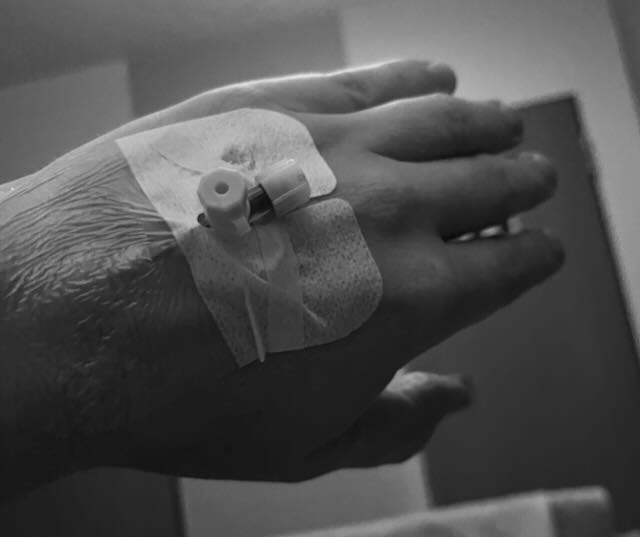
After I’d already lost my access lines a few days before, I got such a one back again. After every pulling of an access line, every removal of a tube, had felt like a step back into normality, the new access line seemed to me like a force that pulled me back to where I’d just come from. As if I’d gone back a stretch on the way out of the hospital.
What do you do there? I learned a new term: “lege artis,” when the doctors talked among themselves. I don’t know whether the doctors noticed that my residual Latin was sufficient to notice that they were really just saying: “Let’s do this by the book.” Okay, strictly speaking, according to the rules of the art.
And according to the rules of the art meant: load up medication for rhythm stabilisation over a few days (the medication needs a certain level in the blood) and, if necessary, give the heart a nudge with an electric shock if it doesn’t jump back into the normal rhythm by itself. Since I was already in hospital, they chose the fast loading. In the end I got both, and since then my heart runs perfectly again.
The side consequences of this treatment were annoying. I had to stay longer, and I had to continue wearing my monitor the whole time. To picture it: it’s a plastic bag that you constantly have hanging around your neck. At some point this strap annoyed me endlessly. It was to accompany me right up until shortly before the end of my stay in hospital and was also that thing which prevented me from showering. Electronics react in a maximally unrelaxed way to water. I think for the last hour in hospital I no longer wore it. On the subject of showering I’ll write something more later, in the next chapter.
There was also a cable that I haven’t mentioned so far, because I’ve saved up the absurdity of this cable until now. There was a cable that was still poking out of my chest. Not on my chest. It poked out of my chest. This cable would, in the worst case, have served an external pacemaker as access to my heart. For example if my heart had reacted extremely peeved to the operation. It’s quite strange to see, when changing the plaster, that there’s just a cable poking out of you. As if a cable box had exploded and a cable had hit you. Since this cable was necessary for the further treatment, it also had to remain in place for the time being. Even stranger, though, was the moment when this was pulled. But more on that later.
On the day before discharge (you could also say that the discharge was waited with until the treatment could be begun) the rhythm problem was then treated. I was wheeled into a room. My heart was examined once more with ultrasound. A little fluid was found near the heart. But there too I can say to the reader who’s preparing for an operation themselves: that’s normal within a certain framework and is treated along the way during convalescence. If I understood it correctly, that’s a side effect of the use of the heart-lung machine. I’ll jump ahead in time here: by mid-December this accumulation had then also completely disappeared on my last ultrasound.
Back to the hospital: I was then briefly put under anaesthetic once more. My heart received the nudge via the cable. And since this treatment it ticks normally again. You take the medication for the rhythm beyond that for a while too, so that it stays reliably stable until the heart has recovered from the trespass in the chest and everything goes its accustomed way again.
Along with the medication for the heart rhythm you have to take blood thinners. Apixaban, also known as Eliquis. To be precise. At this point my father and I can now help each other out with tablets. These are supposed to help eliminate some potential complications of the atrial fibrillation, should it appear again after all. The stroke risk is elevated with the fibrillation, so you thin the blood so that this risk is lowered again.
Blood thinners I’ll have to take my whole life because of the prosthesis. However, aspirin will soon suffice for that. The apixaban is now for the time until it’s certain that the fibrillation is gone. I’m really grateful not to have to take warfarin or heparin my whole life. This would have been the case if I’d woken up clicking with an artificial heart valve after the operation. Currently I just have to take a medication somewhere between aspirin and heparin.
However, even these blood thinners are quite annoying when you get pricked for some reason. Someone always wants to have blood after such an operation, after all. The bruises that resulted were sometimes really astonishing. The contact of the legs with any kind of edges also leads to longer-lasting reminders of that moment. I’m not a person who navigates nimbly around the obstacles in a room. I’m rather a person who likes to catch their shin on some edge.
Even if this challenge is, for many people, part of the first while after the operation, so to speak a normal course of things, I’d gladly have done without it. But I wasn’t surprised that such a thing would happen. I knew, through my preparation for the operation, that such a thing could happen.
In the end it’s a double-edged sword: lots of information means lots of worries. But you’re not so surprised when some hurdle looms up before you. When you inform yourself, you worry that everything you find out will also come to pass. If you don’t inform yourself, you’re surprised by everything and have to wait until someone knowledgeable tells you whether something is to be expected or not. Whether you have to worry or not.
My cardiologist told me later that he sees this phenomenon regarding a heart rhythm thrown into disorder post-operatively very, very often. I’m now supposed to stop taking the medication for the rhythm from the end of the year and discontinue the blood thinner three months later. I’m already looking forward to it. The pill organiser will then be a little emptier.
Perhaps then the bruises will finally stop too. It would be the perfect moment anyway. In March I’ll then want to cycle outside again too, and there it would be quite practical, with regard to accidents, no longer to be on blood thinners.

