(Ein wichtiger Hinweis: Ich bin medizinischer Laie. Ich habe nur lange mit meiner Krankheit gelebt. Ich kann alles medizinische hier falsch verstanden oder falsch wiedergegeben haben. Jede in diesem Text wiedergegebene Information ist potentiell aus dem Zusammenhang gerissen, falsch, unvollständig. Hört auf Euren Arzt! Fehler sind meine Fehler, nicht die meiner Ärzte.Meine Erfahrungen sind anekdotisch. Eure Erfahrungen können anders sein.)
In the last part I wrote that, in the end, I wasn’t operated on after all back then. The first while afterwards turned out to be rather strenuous. Not so much physically. Nothing had changed, after all. But rather in my head. So I also had to deal with a mental consequence of the situation that I hadn’t reckoned with in that form. At first I had to find ways to come to terms with it.
Circulus vitiosus
In my Wikipedia quote about the implications of Laplace’s findings with regard to aneurysms (the aneurysm increases the pressure on the outer walls of the vessel, which leads to a widening of the aneurysm and thus to even more pressure), there was already talk of a “circulus vitiosus.” In my experience there is a second vicious circle in connection with this disease. A mental vicious circle.
So you get the diagnosis: aneurysm. You learn how important controlling your blood pressure is. You read how much blood pressure spikes can lead to problems. And at some point your head learns the connection: “Low blood pressure very good, normal blood pressure good, high blood pressure lousy, very high blood pressure very lousy.” Blood pressure is somehow everything.
Out of that, a kind of low-level fear is always there in the background. No. Fear doesn’t quite capture it. It’s not the kind of obvious fear where you run away screaming. It’s more like a quiet apprehension that plays little games in your head. You start to have apprehensions about high blood pressure. After all, you want to prevent blood pressure spikes as far as possible. That’s why you take blood pressure medication. That’s why you avoid certain activities.
The nasty bit now is the following connection: it’s not only exertion or stress that raises blood pressure. Fear, or fear’s little sister, apprehension, can do it too. Now just imagine you harbour apprehensions about blood pressure being too high because you’ve learned that blood pressure that’s too high is bad. Right. That’s circulus material.
Apprehensions and fear give birth to higher blood pressure. Higher blood pressure gives birth to new fear. New fear gives birth to even higher blood pressure. And that in a situation where you really ought to keep your blood pressure on the low side. Stupid situation. And if you’re not careful, you can manoeuvre yourself into exactly that situation. You can manage to genuinely fret your blood pressure up far too high. It’s important here to watch out a little that you don’t think yourself into such a situation. An apprehension excursion, if you will.
After all, the consequences a bursting aneurysm can have are massive. So one can certainly have the odd apprehension here and there.
How did I come to terms with it? Well, at first with the help of the pharmaceutical industry. Without actually making use of that help. Just the knowledge of having something in the bathroom cabinet with which one can reliably interrupt the vicious circle quickly ensures that this circle gets broken. It’s enough just to think of the fact that one would have the remedy. And the apprehension excursion collapses in on itself without doing anything else.
Later on I no longer needed that. The head creates the problem, the head can also end it again. From mid-2023 onwards I started practising with relaxation techniques. In the end, though, what helped best was what I had been doing for a long time whenever things got a little stressful: headphones on, switch on noise cancellation, eyes closed, wait a moment, start a particular playlist, listen to music. Eyes open again. Carry on working. That actually worked better for me than other relaxation techniques.
I’ll keep using this technique permanently even after my operation, where all of this is no longer quite so critical. Because this technique is also a help for me in focusing when things are coming at me from all corners. Two minutes are completely enough for me there. It was astonishing how well that worked for me.
Perhaps it also helped that at some point I developed a certain calmness regarding my blood pressure. At some point I came to the conclusion that 150/90 isn’t going to kill me on the spot and that I should maybe just close my eyes for a moment and relax. After a difficult phone call, after a lively discussion. After all, those were blood pressure regions I’d seen at times while cycling. And I hadn’t fallen off the bike in years four and five either. Well, I had, actually. But for other reasons. That way the vicious circle didn’t even get going in the first place. I know that isn’t good either, because you then become careless about your blood pressure, but it fairly reliably prevented my blood pressure from getting too high. And I considered a blood pressure of north of 200 to be more dangerous than occasionally accepting such a reading, especially since it was usually completely okay again by the evening.
In the seven years I only got close to a systolic 200 twice more. Once in 2019, the other time in 2023. Both were connected with very emotional situations. But both times I was able to catch it again, even if the second time was easier to control because I’d gathered a certain amount of experience with it.
And one more tip: don’t measure your blood pressure too often. That’s my personal experience. Measuring too often also leads to blood pressure that’s too high. I handled this differently at the beginning, too. Because I knew the significance of blood pressure for the aneurysm, I measured far too often. That was the case in the first months after the diagnosis, when you’ve just been told everything that’s going on and what can happen. It took me a few months after the diagnosis to push this back down to a healthy level. At some point I measured in the morning and in the evening. And that was it. Not also in between, just because the device happened to be lying so close by on the desk. I still keep it that way even after the operation. Anything else seems to me to be “too much information.” In hospital and during the follow-up rehabilitation, after all, it was likewise only measured morning and evening.
Blood pressure
When much of your thinking revolves around blood pressure, you also learn a lot about blood pressure itself. The recommended optimal blood pressure is nowadays below 120/80. Anything else already counts as elevated. Although I may not be up to date there. I’m a layman, too. Now a lot of people grumbled about Big Pharma again over these numbers, with “They just want to manufacture sick people,” because it seems so low to them.
But there’s one thing you have to know about the 120/80: they’re to be measured under optimal conditions. Not after you’ve just dashed up three flights of stairs to the doc. Not after you were stuck in a traffic jam, couldn’t get a parking space and are actually already late. Not after you grabbed a 0.75-litre bucket of coffee on the way to the doc and, to be honest, are late because of the queue at the bakery, not because of the search for a parking space.
Five minutes of rest before measuring. To avoid white-coat blood pressure (which I suffer from badly), actually even without a doctor present. Feet next to each other, not crossed over each other. Sitting properly. Sitting relaxed. Without pressure on bladder or bowel. Really, on the whole, just as if you were measuring your blood pressure at home in complete relaxation. And then it should come out at roughly 120/80.
And yes … that doesn’t sound like something you can really do well in a practice. I therefore suspect that doctors already subtract something from the measured value per se, or schedule the blood pressure measurement within the practice workflow in such a way that you’ve had a bit of rest. At the cardiology practice I go to, the ECG is always done first and then the blood pressure is measured.
I’d recommend in any case owning a blood pressure monitor yourself, so that you can measure on your own now and then. Even if you don’t have an aneurysm. You can get them for little money, sometimes even at grocery discounters. That way you can measure your blood pressure at home maximally relaxed and don’t have to rely on the numbers after the sprint into the waiting room.
If I may make one more recommendation: there are upper-arm and lower-arm devices (to be used on the wrist) for measuring blood pressure. Both probably measure equally precisely from a technical standpoint. It’s just that with the lower-arm device you can do a lot more wrong, whereas the upper-arm device actually sits quite nicely in the right place in relation to the heart. I’m very satisfied with the Omron Evolv. It’s a device for the upper arm. It measures while it’s inflating, and not like other devices, which first inflate and then release the cuff and measure during that. The cuff is orientation-neutral. You don’t have to check exactly where the tube and the arm are. On top of that, it’s small enough that you can take it along easily. And socks or a Krtek will fit into the cuff. It also has Bluetooth, and everything is better with Bluetooth.
I once found the device on a trip abroad in 2017 in a Target near San Jose. And because I was looking for a monitor where I wouldn’t have to write down the numbers for the doc but where the mobile phone would take care of that, I took it with me. And I’ve stuck with this device ever since.
Even though I had to mess around quite a bit to pair it with my iPhone, since the software for devices bought in America was only available in the US App Store. My iPhone, however, was obviously tied to the German App Store. Why on earth? That produces blood pressure. I later destroyed the device through a piece of stupidity. It is, you see, not waterproof. But then I bought the German/European version of the device again. I’m satisfied with it. I’m not linking it here as an affiliate link. Just search for it at the electronics dealer of your minimal distrust.
Krtek
I just wrote that you can stuff a Krtek into the cuff of the blood pressure monitor. But what the heck is a Krtek???
Going away overnight on a business trip again for the first time after all that took some overcoming. A great deal of overcoming. Before that I’d always managed to organise the business trips in such a way that I didn’t have to stay overnight. That couldn’t be kept up permanently, though.
But I had help: I had a lucky charm with me. I don’t even know whether I should tell this story, but I’ll share it here anyway. Even at the risk that you’ll stare at the screen with a big “Huh? The guy is over 50, isn’t he?” The whole thing actually started with a joke I made for my own amusement shortly after Krtek had come into my life.
In 2016 I was given a plush toy by the children of the sister of my then partner. A little Krtek. The mole that most people here in Germany know from “Die Sendung mit der Maus.” And since I liked watching “Die Sendung mit der Maus” (and still enjoy watching the factual stories), Krtek is part of my past. Krtek is a very widely travelled mole. For example, here’s a photo from 2016 in a British Airways A380 heading to San Francisco. There are also a few photos of him from 2017 in front of the clock tower on the Oracle campus in Santa Clara (I hope no colleague saw me back then when I took the photo).
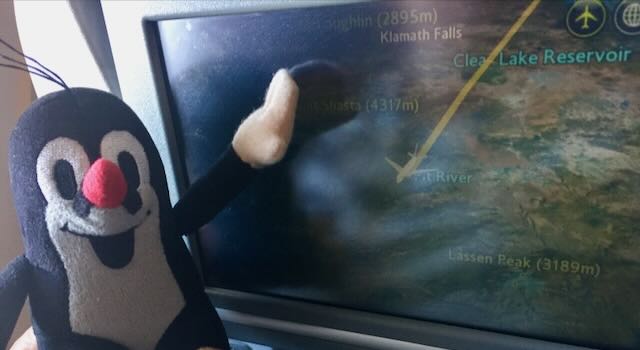
And yes, I know … photographing a plush toy in all sorts of places around the world is stolen from “Amélie.” A film I rather like. You can tell the film was shot before September 2001 (it was released in August 2001). You probably wouldn’t be allowed to pack a garden gnome in your luggage today. Certainly not in your hand luggage. What with the pointed cap and all. But it was with these photos that taking the mole along had its beginning.
Krtek was actually always in the inner pocket of my backpack. Except for two trips since I received him. Otherwise he was always along on any significantly longer journey. The first exception: that business trip to Koblenz. I was travelling without a backpack, only with my wheeled suitcase. And so Krtek had stayed at home. And you know what happened then.
These days I even turn around when I notice I’ve forgotten him. I usually check again when I’m on the B4 in Lüneburg (or just before I’ve got onto the A7, back when I lived in Hamburg for the year) whether I really did pack him.
After that I only accidentally left the mole at home one more time. I regretted this second forgetting of the mole just as much: it was a longer journey in 2023. During the trip my tailgate was smouldering because the tube for the rear wiper was leaking and was dribbling its contents onto the number-plate light. I only recognised this when there was a completely dry spot on my tailgate on an otherwise wet car. On top of that, this spot had a considerably elevated temperature when I touched the metal there. It was so hot that I had to pull my hand back. I was quite shocked, and you could tell.
Weeks later I still had a touch of headache after the journey. The fumes certainly weren’t healthy, and there were traces of soot on the inside of the metal. Back then, in that city where I was, I drove to the VW dealer. There was nothing else to be done but to unpin the number-plate light from the connector and send me off to Lüneburg with it. They hadn’t seen this phenomenon there before either. Apparently there are no fuses for it. I then drove about 700 km back to Hamburg with the windows open.
As a result, I used a workshop loaner car for quite some time afterwards, because even VW found this problem unusual and the situation had to be investigated. I’d only noticed after the journey that my plushy mole had stayed at home on the desk. Obvious that something had to happen on the trip.
He now shares the job with a plush Hamburger that I was given for my fiftieth birthday, and a little Ottifant that I acquired last year at the Otto-Hus in Emden, when I started my bike tour in that city.
I’m getting older. Looking after myself is increasingly a 24/7 job. To manage 24/7 coverage you actually need five people. Three for the 24/7 coverage, one person ill, one person on holiday. But plush toys neither get ill nor do they take holidays. They’re simply there. That’s why three are enough. They now sit up on top of my desk lamp again, the one I bought myself last year. Currently accompanied by a plush fir tree. It’s nearly Christmas, after all. A plush fir tree drops fewer needles than a real fir tree. And I hate artificial fir trees.
I also had support with me during the operation in 2025, which I’ll report on later: I thought the operation justified a higher deployment of personnel. So Hamburger and mole were on duty in the hospital. The Ottifant kept watch over the lamp and my desk. I only bought the Ottifant last year. He was still in lucky-charm training. So I didn’t want to start him off straight away with the operation.
In all seriousness: for some reason (I know it, but I’m keeping it to myself. Sorry.) it ended up being little plush toys for me, but I know plenty of people who have objects that hold a very great significance for them and that they carry with them in special situations. A distant acquaintance once told me that she takes her grandmother’s fountain pen along to every important professional appointment. She doesn’t use it. She just has it with her.
Okay, fountain pen now sounds a little more distinguished than a plush mole. But here too I’m of the opinion: whatever floats your boat. These objects are artefacts that connect you with important points in your own biography, that connect you with your own life. We call them talismans, but really they’re anchor points that remind you of the good and the beautiful in life. They certainly don’t bring luck. They bring memory. And that helps in many situations. Even if it’s only a smile they conjure up. It’s not the mole or the Hamburger. It’s the thought of what you associate with it, of how you received it. Behind it there are always connections to other people, connections to moments, to better times. And those help when you happen to be lying in a hospital, when … yes … when cables and tubes are poking out of you.
It’s also at the same time a ritual. Everything is prepared. Just pack the mole now. Now we’re off. Whatever happens, you’re prepared for it. Because you even thought of the mole. Even if you do sometimes still forget to close the shower-gel bottle properly. I’ve been really grateful for the invention of the zip-lock bag ever since. Don’t ask how I know.
I also know that it’s pure coincidence that this mess happened of all times on the trips where the mole was forgotten and didn’t come along. I probably no longer remember the mess that happened on other trips, either. Though ending up in hospital in Koblenz and a charred tailgate do stand out clearly from the normal mess, so that I’m convinced of Krtek’s effect.
Why am I writing about this, even though it admittedly may sound a little odd for a person of my age? I recently had to wait in hospital for a follow-up examination. An elderly lady was wheeled past me. With a plush toy lying at the top end of the bed. Given to her by a grandchild, I suspect. So it doesn’t seem to be all that unusual.
Sport
So my operation had been called off, but only postponed. The doctor at the Albertinen hospital had also made that very clear to me. The problem was not out of the world.
When I was back home, I made a decision: I wanted to push the day on which I’d once again be facing all the worries about the operation as far into the future as possible. Delay the operation date. I wanted everything to stay the way it was. So get fit, lower my blood pressure as far as possible.
In April 2019 I had a discussion with my cardiologist on the subject of sport. The weight loss I’d started after the diagnosis in December 2018 was stagnating. And I was sure that further successes would only come about with a moving backside. I started cycling. Later even with running.
Up until 2022 I did a really large amount of sport. I cycled very long distances. In one year, 20,000 km. That was so far the longest distance I’d covered in a single year. I ran a really large amount in 2020.
And that was my path, the one I described as the third way between operation and taking it easy. I did something that actually didn’t fit the disease at all. I deliberately chose forms of sport that don’t have the reputation of putting strain on the aneurysm. I always rode in the aerobic range. During my rides at home (I have an indoor trainer) I regularly measured my blood pressure. Together with eating less, that led to a strong reduction in weight and to a time when I really felt comfortable in my own skin, even though I knew that my problem lay beneath that skin.
I got laughed at by colleagues when I suddenly started saying that you could go running very well near a certain hotel in Cologne. Of all people, from me. I was in Cologne a few times for work during that period and had gathered that experience there. From the hotel across the Severinsbrücke, down along the Rhine, across the Hohenzollernbrücke back to the other side, up along the Rhine and then back to the hotel. No special route.
It’s just that this was a comment from someone who actually wasn’t suspected of moving around much in a sporty way. And for some people that was the joke in itself. Despite the aneurysm, I’d been in the form of my life during that time. 160 km cycling. 21 km running. Unfortunately, splashing about in the bathtub doesn’t count as swimming. Otherwise it would have been a triathlon. The whole thing went downhill at some point, though, when I fractured my ankle in a pothole in a nearby forest. Since then nothing has really run smoothly on the sport front.
My idea back then was that, if I had to go on the table anyway, I wanted to do it in the best possible form. Unfortunately not much of that remained. There were many reasons for that. So I then went into the operation this year in a “so-so” sort of form. It worked anyway, as you can see from the fact that I’m writing this text. These days I’m sitting on my indoor bike again and can already feel that my legs want to go again.
Foreseeable
The diameter of the aneurysm didn’t change significantly for some time. All within the margin of measurement error. I really thought it would stay that way. In my mind I was already preparing for an operation after my retirement, even though I didn’t really think that was realistic. Sometimes it was a millimetre more, sometimes a millimetre less. And even though I was putting myself under such heavy strain with the cycling, that seemed to have no effect on the diameter of the aneurysm. I had the hope that it would stay that way for a very long time.
But whenever you have a hope that is actually unrealistic, there’s also the point at which this hope gets destroyed. When the world says: “Yeah, nice thought, but nope.” And shows you the middle finger.
I believe it was in October/November 2022 when it was made very clear to me that it wouldn’t stay that way. The values in the ultrasound check-ups started to rise. Not in huge steps now. But they were rising. A bit more than you could pass off this rise as measurement error. My hope that I might not reach the threshold for the operation for another 20–30 years was thereby done for. In that moment a lot changed. “Someday” turned into “foreseeable.” My hope that I merely had a particularly large normal variant of the aorta, one that had always been inside me, was destroyed.
Instead it was replaced by the no longer dismissable realisation that a pathological process was underway, one that would presumably gather even more speed and would inevitably bring me onto the operating table. Realistically, a 48 mm normal variant wasn’t really good either. But “It’s growing!” was once again a completely different statement.
Back then that tore away my illusions and afterwards a bit of the ground from under my feet. I tried hard to hide it well at the time. It took me a while until I’d restored my inner balance. Until then I was, more or less as in 2018, once again a cork in the whirlpool of my thoughts.
I know, of course, that the normal-variant thing was an illusion. Something I used to calm myself. At any rate it was, from today’s perspective. But you always look for ways to cope with a situation that isn’t entirely simple. I’m still chewing on 2023 to this day. A lot happened in that year. I wouldn’t speak of an “annus horribilis.” For that, things can still go a lot worse, as I was given to observe. But it was already very problematic. I don’t want to complain too much, though: 2023 wasn’t only bad. Professionally, 2023 was the time of my greatest success so far. Probably because I distracted myself with it and threw myself into the project with verve. Because I focused on the project. A project I’m proud of.
Since then I’ve concerned myself with painstakingly precise blood pressure control. I found a way for myself to circumvent situations that send blood pressure shooting up, so that they don’t escalate in the first place. I even bought myself an e-bike later, to control the strain even better there too. I haven’t, however, got back to being as fit as I was after 2018 and before 2022/2023. But I hope I’ll get there again.
I was, within a certain framework, quite successful with my attempt to halt the progress of the aneurysm: from then on it took a good two and a half years more until I reached the threshold that made the operation unavoidable.
I don’t know exactly why it then went relatively quickly in 2025. It must have happened sometime in the spring. I made a decent jump from the second-to-last to the last measurement in the direction of the operation. I have an inkling of when it happened. Of when the aorta widened again so properly. It’s a sort of feeling. I can remember very precisely the situation when my blood pressure shot up properly once more. And I thank the persons present. Not. But this connection, too, may have been pure coincidence.
In the eighth part of this article (which by now consists of 41,474 words – in that moment in which I write “41,474” for the first time; the second time, 44,883 words) things then get serious. It’s 2025, and the operation is imminent.

