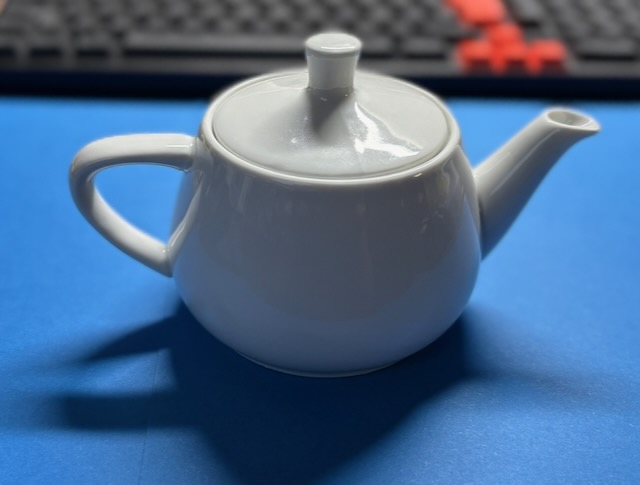

A few days ago, I found something I had been looking for for quite a while. A teapot. Not just any teapot, but a very particular one. Well, one just like it, not the very one: that one sits in the Computer History Museum.
By the way, that museum is well worth a visit if you ever find yourself in the area. If you want to be very cynical about it, it’s the ultimate box of old cables.
Anyway: there’s a teapot there. The so-called Utah teapot. Utah, because in the mid-seventies Martin Newell used this object1 as the template for a 3D model during his work at the University of Utah. It was one of the first models built not from polygons but from Bézier patches. Teapot, because, well, it’s obviously a teapot. Or, as we’d say back home, a Teepott.2 The University of Utah even has an official website for it, and for its 50th anniversary Newell and colleagues gave a talk about its history at SIGGRAPH.
The teapot is a fairly common Easter egg. I first saw it in the Windows “Pipes” screensaver. It also shows up in Toy Story. And of course, Tom Scott made a video about it.3
Of all things, this teapot has a strong connection to my old home. It was made by Melitta, which makes it German. Melitta sold porcelain too, not just patented coffee filters. But it gets even more local: it was manufactured as the “Haushaltsteekanne” (household teapot) by Friesland Porzellan,4 in Varel. Varel is barely 40 km from the backwater village where I grew up, and less than 30 km from where I went to university.
By the time I realized I absolutely had to have one of these teapots, it was too late to buy a new one. A few months earlier, large parts of the Friesland porcelain factory had burned down (article in German). There it was again: my impeccable timing.5 None of the shops selling new porcelain had it anymore. After three years of on-and-off searching through junk shops and flea markets, a vintage porcelain shop on Etsy finally came through.
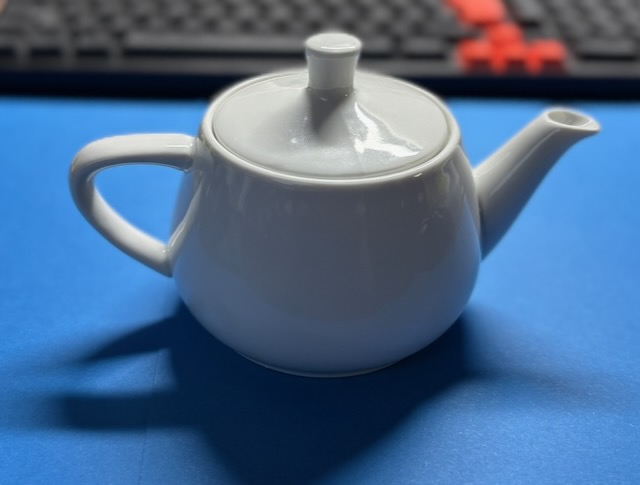
So now I own a teapot that’s probably around 50 years old. Of course, I can’t be sure it isn’t a fake. But who would fake a teapot that was produced by the millions? The market for teapots among nerds with a collecting habit probably isn’t that big.
-
The idea came from his wife, Sandra. The two of them were having tea when she suggested he simply model the tea set. ↩
-
Every now and then, I’m genuinely amazed at how close Low German is to English. The “Koppke” in the universal East Frisian troubleshooting strategy “Eerstmal en Koppke Tee” (“first, have a cuppa tea”) seems too close to “cup of tea” to be a coincidence. And as Newell’s example shows, the strategy even works in Utah. ↩
-
Is there anything that man hasn’t made a video about? ↩
-
Not to be confused with East Frisia. Friesland, meaning the district of Friesland with the license plate code FRI (which locals like to translate as “Fahr richtig, Idiot”, roughly “drive properly, you idiot”), is not located between East Frisia and West Frisia (which belongs to the Netherlands), but east of East Frisia. North Frisia is indeed north of Friesland, but it’s further east than East Frisia, and even further east than Friesland. Apparently, whoever handed out the names hadn’t yet learned “Never Eat Shredded Wheat.” ↩
-
I should have bought it when the teapot first came to mind as a gift idea for someone with a soft spot for computer graphics. That was a few weeks before the fire. I put it off because the birthday was still a few months away. In the meantime, everything went up in flames. Like I said: timing is my forte. ↩