This is not a review, and I don't hand out stars either. It is part of my annotated reading list. Whatever first comes to mind when I pick up the book. More about it in this blog post. The English text is a translation made with an LLM, which I check and revise myself.
written on November 26, 2026, first read November 2026
In my text about my aortic surgery I wrote the following at the end of the third part (in German): “But here, too, I had the hope that everything would somehow turn out okay. Because so far everything had turned out okay. Not great. It could have turned out nicer with other decisions. To quote Mr Kunze in slightly altered form: ‘I have so much luck on my conscience.’ But somehow okay.”
But what if you could look up what would really have happened had you made other decisions? The basic idea of this book is really interesting: somewhere there is a place where you can put yourself into all the lives you have not lived. Trying on a life that your own decisions stood in the way of.
The book is “The Midnight Library” by Matt Haig. I did write that I have my problems with self-help books. But at bottom, this book is just such a self-help book.
The idea is not really new: I fairly quickly thought of “Tapestry”, that episode of ST:TNG in which Q1 gives Picard the chance to lead his life differently, after a decision at the beginning of his adult life had cost him his own heart, which many years later, in a roundabout way, proved fatal to him – and then shows him what consequences that would have.2
Whenever doubt arises in me in the form of “If only you had done that differently back then”, I remember this episode and think: “But then you would be a different person now, too.”
The book is completely unsubtle in a subtle way. Or rather subtle in an unsubtle way. Yes, I think that describes it better. I do not really know whether that makes sense. It is so terribly unsubtle that the ending is actually entirely foreseeable after the first third of the book.3 The subtlety actually lies in the fact that you start thinking about your own life and, while you are reading, are not really paying attention, but are thinking about what would have happened if you had made a different decision here and there. And I believe exactly that is the author’s real intention. A book does not necessarily have to be high literature, does not necessarily have to hide its message in constructions of words, in order to have an effect. Or perhaps precisely because of that: after all, Foucault’s Pendulum has been sitting on my shelf for decades without having resonated enough for me to finally read it to the end.
I wrote about the episode “Tapestry” further up: for roughly that long I have also been haunted by the thought of what would have been if I had decided differently at this or that point. Had gone to the new school one day later. Had said something at some point where I said nothing. The Book of Regrets in the Midnight Library was already well filled for me back then, too. Those thoughts when you sit on the sofa in the evening and it becomes quiet. It is exactly this nerve that the book hits. “Tapestry” is perhaps the more effective story there. It shows all of this by means of one alternative life, whereas the book needs several lives tried on. But perhaps you also need a benevolent omnipotent being for that, instead of an imagined “guide”4 from your own past. And, of course, the constraint of having to tell the whole story in 45 minutes. I only know that, when it comes to the doubts mentioned above, I will in future, too, remember the TNG episode rather than the book.
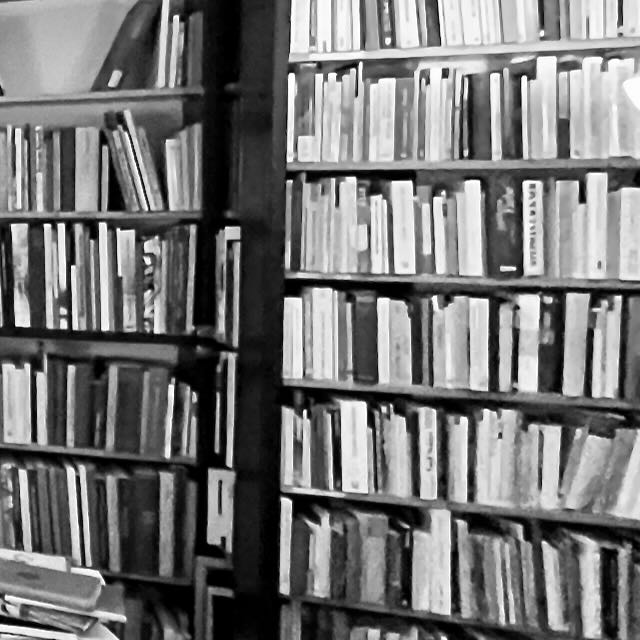
I wonder what the Midnight Library would look like for me. I am torn as to whether it would be books for me as well, or records. Or a blog.
PS: I have the book in a decorative edition. At first it somehow looked as if it had been farted out by a unicorn or Nyan Cat … colourful, very colourful … until I understood that it is modelled on the way the books in the Midnight Library are described in the book. That I have the book in this version is more of a coincidence. I bought it a while ago on a reflex, and it was the only hardcover version available at the time. It lay in the shelf inbox for a long time. Now I have finally read it, because after the book about nuclear annihilation I needed something more pleasant.
-
Alongside the Borg, Q was one of the best ideas of the series. ↩
-
By this point at the latest, the “revelation” of why Q kept pestering Picard, from the last episode of the second season of “Picard”, should no longer have been a surprise to anyone. ↩
-
As the book is fairly new, I will not spoil it now. ↩
-
I am writing this so plainly here because it is completely clear after just a few pages. I do not regard it as a spoiler. ↩