(Ein wichtiger Hinweis: Ich bin medizinischer Laie. Ich habe nur lange mit meiner Krankheit gelebt. Ich kann alles medizinische hier falsch verstanden oder falsch wiedergegeben haben. Jede in diesem Text wiedergegebene Information ist potentiell aus dem Zusammenhang gerissen, falsch, unvollständig. Hört auf Euren Arzt! Fehler sind meine Fehler, nicht die meiner Ärzte.Meine Erfahrungen sind anekdotisch. Eure Erfahrungen können anders sein.)
Leaving Bad Bevensen
In the last days of the follow-up rehabilitation I had already clearly noticed that I had increasingly slipped into the “Right, that’s enough now” state of mind. You leave the rehab clinic relatively early in the morning. On the last day of the follow-up rehab the programme ends at 08:30. Probably because many people then still have a longer journey ahead of them, for instance going home by train. But I had also observed that there were a number of people who waited down in the foyer for a long time until relatives came to pick them up. I always felt very sorry for them when people sat there with their packed suitcases. Somehow lost. In the truest sense: ordered but not collected. Meanwhile the rooms are already being prepared for the next people. So you don’t get a chance to wait in your room either.
I had thought several times that I actually couldn’t wait to reach the end of my follow-up rehab too. On one day it was terribly foggy in Bad Bevensen. People disappeared into the fog with their wheeled suitcases and were on their way into life after rehab, and for most of them into a life after an event such as a heart attack or – as in my case – after major surgery. On that day I stood on the balcony of my room and actually found that a very beautiful allegory (yes, that is my use of the word for this year) for the mental world I found myself in at that moment. Around the hospital you could see where things were heading, but everything that was a bit further away disappeared into the fog. And somehow everything felt exactly like that. At that point I still had no idea how everything would now continue. It was all still in the fog.
Physically I felt increasingly fitter, but the question of what effects all of this would have on me mentally was somehow unclear to me. In the fog, precisely. However, I also knew that, when you walk through the fog, the bubble of what you can see shifts along with you. At some point the hospital and the rehab clinic would disappear into the fog behind me, and I would perceive new things ahead of me.
At the end of the follow-up rehab I had already decided not to sleep at the hospital any longer. For the last two nights I was already back home in my own bed. That lifted the fog a little for me. I wanted to know how I would cope with the fact that there was no longer a doctor on site at the push of a button. On both days I also no longer ate in the patients’ restaurant. That was also connected to the fact that the lottery of who sat next to me had now, after that person with the suspect band hoodie, dealt me someone who from my point of view was quite clearly suffering from a cold. And I had little desire to sit next to them. I only had two days left and didn’t want to drive my tissue consumption up considerably right on the finish line.
Then comes the last day. No more treatments take place. You have no appointments. The last blood draw was already two days ago. You hand in your room key, the vital-signs records. In return you receive the medical report. And that was it. I had already taken my luggage home a day earlier. The last ride in the lift down to the ground floor. The golden lift ride, so to speak. The last time through the glass doors and out.
I stood in front of the hospital. The time after the operation had then truly begun. Even if so far it was running quite differently from how I had planned. I actually wanted to write a coda explaining why parts of the time were difficult. But that would mean describing another person’s path. And I don’t want to do that. I’ll only say this much: it is not my fight, but I am fighting alongside. That has to be enough at this point. Forgive me that, in the end, the promised coda is missing.
How are you?
Friends have been following my text. In the past few days I have been asked several times how I am doing. Was it my personal Armageddon? Was it actually quite okay and less bad than expected? A walk in the park? The last chapter was actually planned as a somewhat shorter chapter. But in the end I did want to answer this question here.
The answer is complicated. Because it can’t be answered so unambiguously. Nothing is better, just as everything has got better.
I would say it is most comparable to the Muppets’ Christmas. Chaos, but in the end everything turned out well. And you notice how important friends (real friends) and family are.
Nothing gets better
The operation and the time afterwards are pretty strange. It is about something that I basically formulated a little while ago. The operation made nothing physically better. I wrote that the state before the operation, with the aneurysm, actually didn’t feel all that different from normality.
It is not the case that after this operation you can again do things that were not possible before the operation. It is not like a broken heart valve, which can restrict you massively and where the replacement gives you back this capacity within a certain range almost immediately.
With this operation you come out of a state that feels physically normal, and you first end up in a state in which you feel weak, and you have to work your way back to normality. You have to transform yourself from absolute helplessness in the hours after the operation back into a functioning individual.
What you get for it is something very abstract: risk minimisation. Something you can’t really grasp like that. That makes it hard to come to terms with this operation mentally. And it doesn’t make it any easier to cope with the operation and its aftermath.
It feels as if nothing gets better, but in fact everything is better. There we are again with risk assessment. Minimising risks doesn’t trigger anything in the brain regions responsible for reward. Unlike when, for example, you can climb a staircase again without having to catch your breath on every second step. A really strange situation. The thought that you can lift something without having to worry that something can – but doesn’t have to – happen is very abstract. After all, you could already do it before; you just shouldn’t have.
Everything is better
At the same time, life is now a different one. What determined my life for the last seven years is now gone. Something has fundamentally changed. Everything feels better. A burden has been taken off my shoulders. You recognise it in small things, in mundane things. Before the operation I eyed every shopping basket askance, to consider whether it might be too heavy. By now I just grab it and carry it into my flat. They are not too heavy. But seven years of packing shopping baskets so that they all weigh roughly the same and none weighs more than ten kilograms – that is still automatically inside me.
This carefreeness returning to daily life: it makes everything better. Not having to think and not having to hold back makes everything better. You just take longer to notice it, because the head needs time to adjust to this abstract change. Because it takes time to notice it by way of small things.
Degree of disability?
My world is nevertheless a different one. The day on which I was at the hospital’s social services also brought insights that I first had to process. In the follow-up rehab there is an appointment in which it is clarified what happens after the follow-up rehab. Because in the follow-up rehab is before the rest of life after the operation. And there, too, you continue to be supported. There were some things I didn’t have to take care of. Long story, which doesn’t belong here, as to why. But other things do require clarification.
It was something else that preoccupied me so much: we agreed that an application would be filed for me on grounds of disability. You can at least give it a try. To be honest, I hope this will be rejected. Because I don’t feel disabled. And I believe it would be a bad start into a new era – an era after the aneurysm – if I were to begin it with a GdB (degree of disability).
But on the other hand: it is probably sensible to file such an application. If I have understood it correctly, my application is based on the fact that I am no longer 100% organic, but rather carry a prosthesis inside me. That I live on blood thinners. We’ll see. It won’t be a high degree of disability. I will still have to park normally. Not even my father has the permit for that, and there it would actually be warranted. For me it is more a documentation of what happened. Who knows what else will befall me in the coming years. Perhaps this documentation will still be important in the future.
But that a degree of disability is even being considered at all is also, first of all, something I have to build into my mental edifice. Because this thought is yet another blow against the belief in one’s own invulnerability. Those remnants that are still left after aneurysm and operation.
Afterwards
I believe I will still need quite some time to come to terms with the new situation. I will still need some time to truly come to terms with what happened, once and for all. Not in the sense that I can work again, not in the sense that I think about it all the time. But in the sense that those twelve weeks in the autumn of 2025 become part of my personality.
I had talked with my GP about the fact that emotionally I wasn’t doing particularly well between the hospital and the follow-up rehab. I spoke. The doctor listened. She thought for a moment and then said something that I had indeed overlooked: “You are still here.” Yes. I am still here. A hard statement. You take it so much for granted. But it is not as self-evident as you think. But she was completely right. I am still here. And happy about it.
Every day since the operation is a gift for me. I have resolved, after this operation, to mark the 30th of September somehow specially every year. I don’t yet know what I’ll do. Barbecuing with friends and family. Driving to Staberhuk. To that beach near the naval radar station, overloaded with memories, that means so much to me.
I hope that, until my passing, when old age eventually carries me off, I will never come as close to the state of death again as I did on that 30th of September. It is of course clear to me that I was constantly carried by the doctors so as not to fall in the direction of death. But it feels as if I would only have had to turn off differently at some point, and I would no longer be here. And that, too, is something you first have to come to terms with.
This coming to terms with it disturbs you quite a lot when you try to concentrate on something. This text, for example, took ages. My concentration is currently coming back. I noticed that I was able to write on the text a little longer each day. So if, after such an operation, the thing with thinking doesn’t work so well for you: it was the same for me, but it passes. You are busy with it for quite a while. I will be busy with it for some time yet.
Three months later
Today is Christmas Eve. The last three months have been exhausting. Emotionally stressful. Physically demanding. Circumstances within my circle of friends and relatives (I am deliberately remaining vague) made the time far more exhausting than I had expected. But I also noticed that I am considerably more resilient than I had expected.
I had the fear that the situation would change me to my disadvantage. I believe that has not happened. But the jury is still out on that. The old Jörg from before 2018 is not back yet. After three months I have come to the conclusion that he won’t be coming back either. Something new is emerging. Shaped by the seven years between diagnosis and operation. Shaped by the last three months. Both in a positive and in a negative way. But “I am still here” lets me look positively into the future, even if the universe has, in some places, already shown again that it laughs maliciously when you make plans.
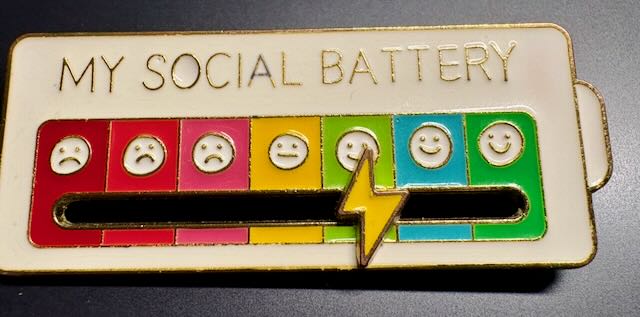
How is my social battery doing? Well, better, considerably better. If I look at the scale in absolute terms. I would say there is room for another little notch in the future. I won’t rate the battery as a social Nutri-Score that measures relatively, in categories. What counts as depression among carnival-goers is probably a Tuesday for North Germans. My social Nutri-Score would therefore be over to the right if I compare myself with other North Germans. Compared with carnival-goers, probably deep red. But I feel ready for the world again. Ready for new things.
In a few days I will be working again. I had already started beforehand to take part in video conferences, so as not to be completely overrun when I start work again from one moment to the next. Here I am grateful to my manager, to many people in the company and to the company as an organisation for supporting me so much. Here I really have to say: credit where credit is due.
Before the operation I thought I could start work again after six weeks. I didn’t want to believe the doctor in rehab when he said that patients usually need three months to become physically and mentally fit enough again to work. This disbelief was absurd. Of the three months, I spent almost half in hospitals on my own. So I only had the other half of the time to recover at home. That is not all that much time.
The doctor was right. I needed the time. My concentration is still not where it once was. I notice it getting better and better. I think it will be good enough in a week to face everyday life again. To face my profession. Last week I bought myself a new office chair, to “celebrate” that things will soon be starting again. Because I know that I will spend a lot of time in it. Because I have learned how fragile health is. My old office chair was admittedly still okay. But for me this new chair is also a sign that things are now moving on. And the chair has such a long warranty that it will carry me almost throughout the rest of my working life. As I wrote: the end of the follow-up rehab, the provisional end of the convalescence, is the first day of postoperative life.
In Bad Bevensen I had wondered why there were so many jigsaw puzzles around. At first I assumed it was just a way to kill time. Jigsaw puzzles drive me crazy. At some point I’m tempted to brute-force them. Which doesn’t work. That’s why my attempts to solve a jigsaw puzzle have so far failed. Jigsaw puzzles are just divided-up pictures to me. No really functional connection. The division makes no sense, has no function. One Enterprise-D later, I know that doing jigsaw puzzles is probably a way – a very good way – of refinding your focus. As long as you don’t go crazy in the process. It just wasn’t one for me. The division into parts somehow makes much more sense with Lego than with the die-cut pieces of a jigsaw picture.

I regained a lot of focus through the Lego set. I bought the set, of course, because I’m a big fan of the TNG series. I had no goal in mind in doing so. All the more pleased was I when I noticed how much these 3,600 pieces helped me in the end.
I now feel almost ready again to take on the world. Waiting any longer makes no sense. Even if by no means everything is normal yet, everyday life will help me refind normality.
To answer the question of how I am doing: it still depends a little on my form on the day. For most hours of the day I would say: good. Physically I am sometimes only reminded of what happened when, in the morning after showering, I look in the mirror at the still clearly visible, somewhat red scar on my chest and think: “Oh, yes, there was something.” This scar will never disappear again. It may become less reddish, but it will remain. It, too, connects me with the last three months.
Over the last two to three weeks my body has stopped constantly reminding me of what happened. Even looking over my shoulder has been possible again for a week now without my being reminded of what happened to my ribs. That, too, was a big step forward for me. I am still not really fit. But Rome wasn’t built in a day. Fitness is not created by the follow-up rehab and a bit of training either. That is a task for the coming months.
Done it
Jörg, you no longer have an aneurysm now. I think it still hasn’t quite arrived in my head. On the day I write this line, it is just a little over three months since I was operated on. Six weeks after the operation it hadn’t arrived at all yet. I still remember that time. But slowly it’s dawning.
I will have to take medication for mild blood thinning for the rest of my life (aspirin is enough). I will have to take antibiotics before every dental visit for the rest of my life. But for the rest of my life I will also no longer have to be afraid that, at the spot where the aneurysm was discovered on 26 November 2018, my aorta bursts and I die of it. Everything that befell me in those three months was worth that. I would tackle it again at any time.
And I can only say: even though the fear before the operation was great, the fear you have in life before the operation is considerably greater. You just don’t notice it so much. Because you are fed it in small portions every day. You only notice it when you no longer get your daily spoonful of apprehensions.
I wrote that the state before the operation is also accompanied by worries and fear. How is it with that now? Fear doesn’t arise in a single day, fear doesn’t go away in a single day either. Uncertainty doesn’t go away in a single day. For exactly that reason you are also unfit for work for a long time after this operation. But I do notice that it is somehow becoming okay. That was my goal. And I didn’t want any more than that.
Merry Christmas
I wish you all the best for Christmas. My lucky charms and anchor points of the last twelve months send their greetings too.

