
I’ve been using a Keychron Q6 for a few years now. And I was, more or less, reasonably happy with it. The keyboard felt decent enough, it looked somehow nice too. Basically a mechanical keyboard for people who can’t be bothered to build one themselves, as I’ve come to understand the topic since.
I could have stayed with that keyboard forever, really. New switches at some point, maybe. New keycaps, maybe. There was no sensible, compelling reason for a completely new keyboard.
I only had one problem with it: it wasn’t wireless. The wireless variant came out a few weeks after I bought my Q6. And so a desk that had been planned as a cable-free desk turned back into a desk with cables on it.
As with everything that only annoys you a little: you let it go, you tell yourself it doesn’t annoy you – until one day it annoys you enough. However, that day never came.
Instead, the the day came a bottle went over. During some warm days - not that big heatwave. With water in it. I saved my notebook, but within seconds I was in the market for a new keyboard. A repair attempt involving generous amounts of isopropyl alcohol produced nothing but a partially functioning keyboard. In that moment of defeat I remembered a recent blog post in my RSS reader and got to work.
What followed for me - at first until i decided about a new keyboard - was a spell in the purgatory of a keyboard so unlike the one my main keyboard had been before it drowned. Not a bad keyboard. An Apple keyboard I own for the sake of the TouchID button. But different enough to feel unfamiliar. Different enough to slow me down. Different enough to annoy me.
Contact
Our contact with the digital is shaped largely by eye and ear. The interaction is barely physical at all. Except for the hands, the fingers. Fingers are our way of manipulating this world. Of putting something into it. Yes, of course there’s voice input, but in the end you still need the keyboard there too, to fix the errors, filter out the ums and delete all the swearing, because the system has misunderstood something again.1
The keyboard is one of our gateways from the eighth to the seventh circle of hell … er … of the OSI model. For me it is the essential tool of the trade. And that settled it: a new keyboard had to happen, and while i was at, it had to be another step up from the Q6.
The new keyboard
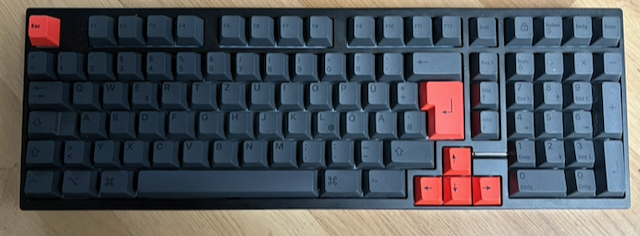
So what did I go for? The case and the PCB2 are a Neo Code 98 ISO Tri-Mode. A “nearly fullsize”, then. The switches are Gateron Oil Kings. Fairly heavy linears. So no tactile bump. Stabilisers3 are AEboard stabs. I wanted TX AP stabs, but they weren’t available. In the way that everything to do with custom keyboards somehow consists of working your way around “out of stock”. “Hey, those look good.” – “Bzzt. Out of stock.”
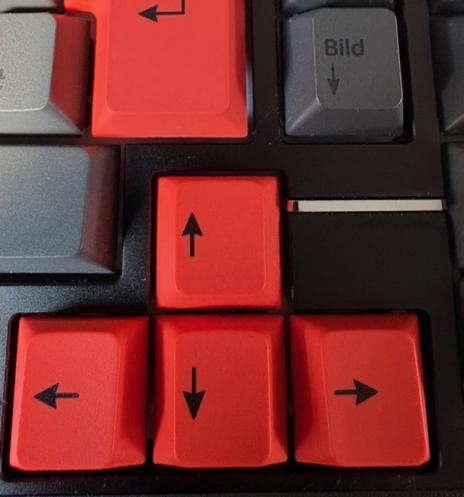
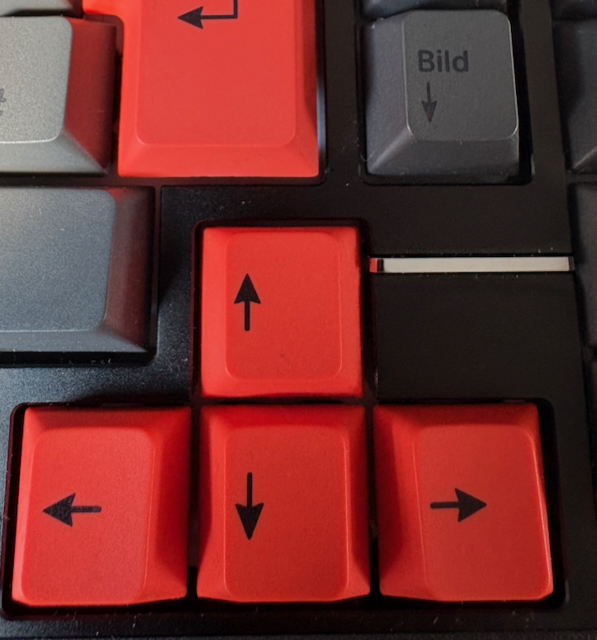
But the internet reckoned the AEboard stabs are practically just as good. Keycaps are Black on Grey by Monacokeys, with Esc, Enter and the cursor keys in black on – some sort of – red. Layout is ISO.
ANSI regularly produces the urge to throw the keyboard out of the window. I rate the ISO enter key, considerably larger than an ANSI enter, rather highly. On ANSI, half of that space is already a different key. I did give it a go once, back when I had an ANSI keyboard attached to a Sun workstation. Never again.
It does wired, 2.4 GHz and BT4 alike. It doesn’t blink. My Q6 occasionally looked like a small-town mega-disco. And for some reason the village disco would switch itself back on now and then, no matter how often you switched it off. The new keyboard doesn’t do disco. It is illumination-impaired. It has no LEDs for this task. And I find that extremely pleasant.
Lessons in humility
A while ago I overhauled a bicycle component. Taken apart, thoroughly cleaned, put back together, noticed that one part was fitted wrong, taken apart again, corrected, fitted again. Strictly speaking the part is non-serviceable and gets replaced as a whole. But “non-serviceable” ran straight into my stubbornness.
All in all, a lesson in humility. Humility that the eyes really do carry every year you have lived. Humility that my fingers aren’t actually suited to fitting the tiniest of screws. Humility that a human being is not granted a third arm, complete with matching hand. In the end everything worked perfectly. Non-serviceable? Pah!
Life apparently decided I needed another lesson. That I might draw the wrong conclusions from the bicycle-part odyssey. And so it all repeated itself. Assembling the stabilisers was a test of patience and of whether my glasses were still the right prescription. And here too an error crept in. I followed the instructions to the letter. Fitted stabilisers wherever the instructions said to. Including at the spot where the left shift key would later have its place. And didn’t really think it through.
The reader will already have spotted my mistake: on an ISO keyboard you usually have a split left shift. So a small shift key with “<>” next to it. For one thing, small keys like that don’t need a stabiliser. For another: that spot has three mounting positions for switches. Left, middle, right. With a stabiliser fitted, only the middle position is accessible; the others are covered by it. And now guess which positions a split left shift needs. Yeeees, correct.
So, go tell them, stranger passing by my desk, that here you heard me cursing, as the extra work commanded.
The error itself is easy enough to correct. Just unscrew the stabiliser. Except that you can’t, not once everything is assembled. Stabs are the very first thing you screw onto the PCB, so in principle you’d have to strip everything back to that state. Which, with a good hundred keys already on the board, amounts to a punishment for people who pushed their parents through Gandalf’s grey curtain. Without said parents being asked. Because the key sat at the edge, I was able to exploit the slight flex of the PE plate and fiddle the stab out without fully dismantling the keyboard. Which downgraded it to a punishment for people who didn’t ring their parents last weekend.
It’s not just “Read the fine manual”. It’s also “Think about the fine manual”.
The first few weeks
So how does this new keyboard feel? It is not some orgiastic typing sensation that drives a surge of emotion through the body with every keystroke. That would be asking rather a lot. Nor is it a pleasuring device for the hands. As though you were bathing them in it like they said in an old german dish soap ad. It is still only a keyboard.
What it realistically is: it discharges its duties at all times to my complete satisfaction. It is better than the Q6. Considerably. And the Q6 was already not a bad keyboard. I noticed that with a certain amount of surprise.
I still have to get used to the relatively stiff springs in these linears. I do notice it in my fingers. The Keychron gave my fingers a good deal less resistance. But it feels good. Like the Keychron Q6, the new keyboard is quite heavy. Around 3 kg. I like heavy keyboards. For a whole range of reasons. Unshiftability. Potential applications during a zombie apocalypse. Solidity. I have a tendency, when typing, to strike the keys as though I meant to drive them through the wood of the desk. Stability is a must for my keyboard purposes. I had that with the old keyboard and I wanted it with the new one. And the keyboard grants that wish without tipping over into the excessive.
And the sound? A deep, agreeable sound with no rattle. “Thock” is what they call that in the realms of the keyboard aficionados. “It sounds good” is what I call it.
So is the keyboard perfect? No. I’m not sure the keycaps will stay in the long run. Black on grey looks good. That subjective beauty comes at the cost of objective legibility. For the moment I like the look far too much to do anything about it. But that may change.
Bubble
On my journey to the new keyboard I passed through all manner of lands. Where the Keychron was simply a case of being influenced by the bubble I was in at the time, here I had to inform myself.
And the people who inhabit these lands are, let’s say, a little odd. How to re-lube your switches properly is a matter of epic debate. The choice of the right keyboard grease5 and the right places to apply it fills page after page of forum threads.6 There are people who go so far as to swap out the springs inside the switches. With others I get the feeling they buy keycaps that come from some Finnish basement underground shop because they … well … come from a Finnish basement underground shop. The videos of people striking keyboards and recording it with a microphone are legion.
It seems that every human activity, every hobby, has its own excess living inside it. I have not, however, descended into those depths of the rabbit hole.
However, perhaps i’m the wrong person to complain about it … a few years ago I spent several weeks on the subject of tubeless rim tape and the matching valves. And I’d rather not start on the weeks of research into which rear hub would be best for my “holiday 2025” plan. Like I said … excess.
Even so, my colleagues registered a certain amount of astonishment that I had assembled a keyboard myself. Apparently that’s stage 4 nerddom …
Postscript
What did I learn from all this? Once again, why the sign at the entrance to the computer room at my school read: “No food or drink”. Forty years on and I still haven’t internalised it. Even though there is in fact a cup holder attached to my desk, from the Swedish emporium of tat with the furniture store attached to it. That holder would have reliably prevented the tipping. But then I wouldn’t have a new keyboard now either.
-
I’m glad direct brain-computer interfaces don’t exist. I would have to check every text for “I remain, yours oh look a squirrel sincerely” errors. ↩
-
The circuit board inside the case that the keyboard is electrically built upon. ↩
-
A shift key is fairly long. If it is only supported by the switch in the middle, it wobbles rather a lot. Or only goes down on one side. To a lesser extent the same applies to any slightly larger key (enter, backspace and so on). So you fit a thingamajig underneath the key to stabilise it. The stabiliser, in other words. ↩
-
Hence tri-mode. ↩
-
Do people actually realise how much that phrase sounds like a hazing ritual for newcomers to a group? Along the lines of the famous floppy disk lubricant. I’m quite sure that if we still used floppy disks on any scale, that would long since have turned from a joke into a valid question. With the inevitable follow-up: “Or would you rather have more wobble?” ↩
-
I suspect that if it served the ultimate thock, they would also be debating recipes involving eye of newt and tongue of frog, stirred in a pot at midnight. ↩